
China — May 28, 2026
As global demand for licensed children’s electric vehicles accelerates, a new generation of multi-configuration ride-on cars is reshaping what wholesale buyers expect from Chinese manufacturers. At the center of this shift is a product category that barely existed five years ago: the officially licensed, multi-motor kids supercar that offers three distinct power tiers from a single platform.
The Platform Strategy That Is Changing the Category
The economics of the ride-on car trade have traditionally been dictated by discrete SKUs — if a buyer wanted a slower entry-level model and a faster premium model, they ordered two separate products from two separate molds. That logic is breaking down.
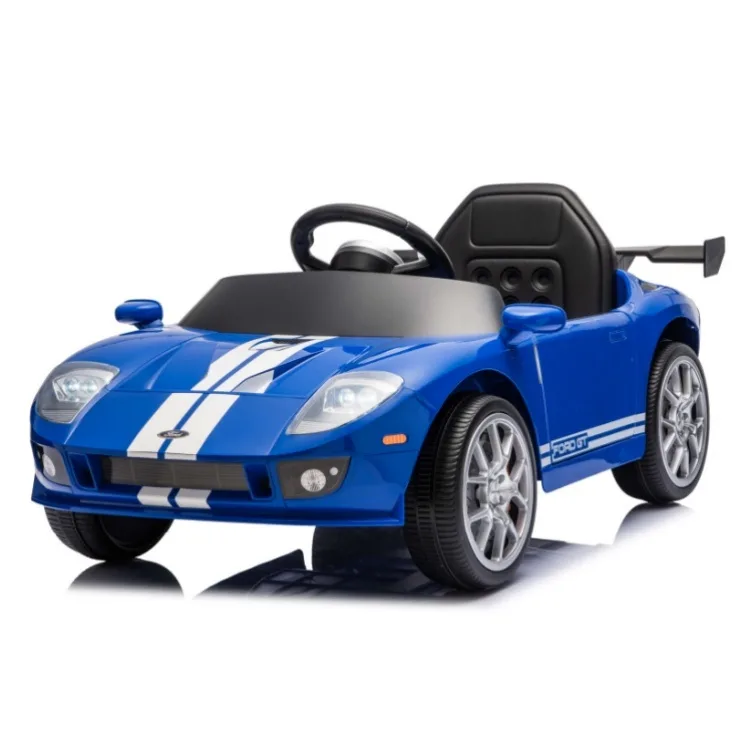
The CL-SHX4507, recently introduced by China-based CHITUO Toys, is built on a single 104cm Ford GT body shell that accommodates three completely different drivetrain configurations: a 6V single-motor setup (390# × 1) for toddlers aged 1–3, a 12V dual-motor standard edition (390# × 2) for ages 3–6, and a 12V quad-motor performance variant (390# × 4) for children aged 4–7 who want more speed and all-wheel traction.
For importers, the math is compelling: one mold investment, one set of spare parts to stock, one packaging specification — but three distinct price points and three consumer segments covered. “You’re not managing three products. You’re managing three configurations of the same product,” a CHITUO Toys representative told us.
All configurations share: identical body shell (104 × 61 × 44 cm), same packaging (0.139 CBM), same 520 PCS / 40HQ container load.
What the Numbers Say About Market Direction
The ride-on vehicle segment — part of the broader $90+ billion global toy market — has seen licensed products consistently outperform generic alternatives in both unit sales and margin retention. Industry data from major trade platforms shows that licensed ride-on car listings achieve 35–50% higher inquiry-to-order conversion rates than non-licensed equivalents in the same price band.
More telling is the shift in buyer behavior: five years ago, the most common inquiry was “What is your cheapest 12V car?” Today, the top questions from B2B buyers are “Which licenses do you hold?” and “How many motor configurations can you offer on this platform?”
Certification Density: 6 Markets, One Product
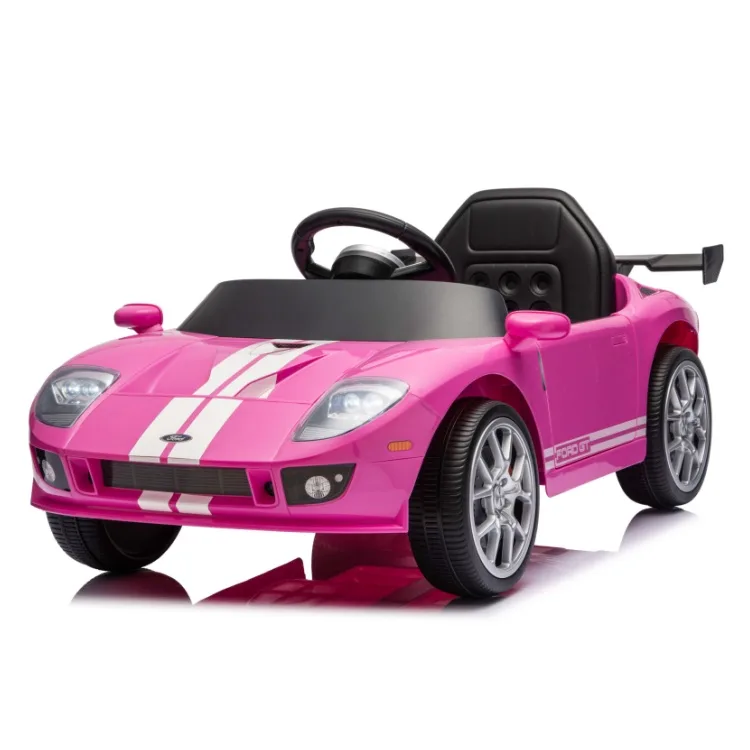
Perhaps the most underappreciated competitive moat in this category is certification coverage. The CL-SHX4507 ships with six distinct safety certifications covering the world’s largest toy markets:
| Market | Standard | Significance |
|---|---|---|
| European Union | EN71, EN62115 | Mandatory for all EU member states; EN62115 specifically covers electrical toys |
| United States | ASTM-F963, CPC | Required for US market entry; CPC (Children’s Product Certificate) is per-shipment |
| China | CCC | Compulsory Certification for domestic Chinese distribution |
| Canada | SOR | Statutory Orders and Regulations compliance for Canadian import |
For B2B buyers, this matters because it eliminates the single largest friction point in cross-border toy trade: re-certification. A product that lands with EN71, ASTM, CCC, and SOR already in hand means the importer can go straight to customs clearance and shelf placement — no lab delays, no re-testing costs, no months of regulatory limbo.
The Technology Trickle-Down in Kids’ Vehicles
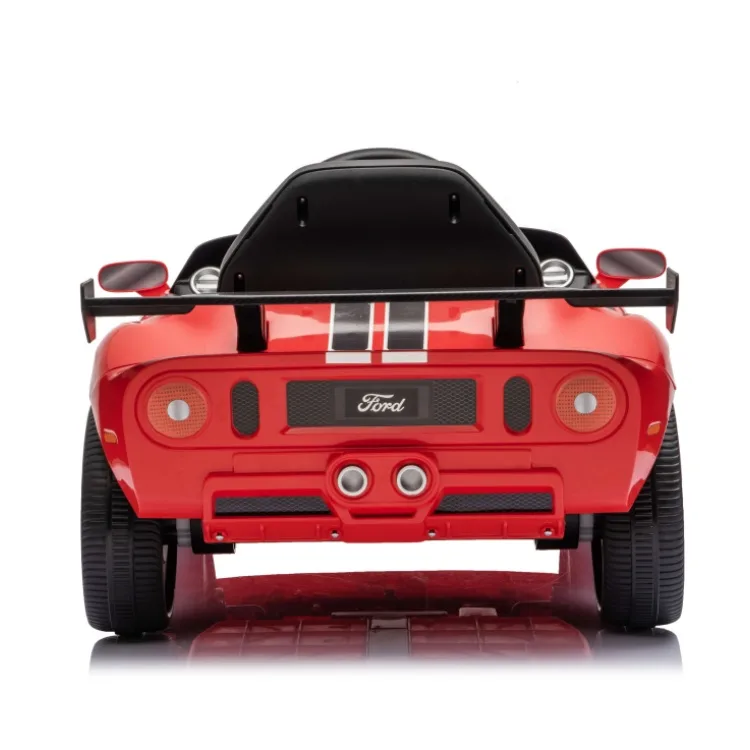
Features that were premium selling points on $400+ ride-on cars two years ago — Bluetooth streaming, dedicated mobile apps, battery level indicators — have migrated down to volume models. The 12V configurations of the Ford GT include all of these as standard, plus 2.4GHz remote control for parental override, USB ports for custom music playback, and LED headlights bright enough for dusk driving.
This technology democratization is partly driven by component cost deflation — Bluetooth modules and app-ready microcontrollers are now commodity-priced — but also by competitive pressure. When a mid-tier product in the $80–120 FOB range ships with features that $200+ models carried in 2023, it compresses the entire category’s pricing ladder, which benefits volume buyers but squeezes manufacturers who haven’t invested in R&D.
Color as a Competitive Dimension
The Ford GT platform offers 10 color finishes: six injection-molded plastic colors (Red, Black, Pink, Blue, Gray, Purple) plus four premium painted options (Red, Pink, Black, Purple) with automotive-grade gloss finish. This is unusually broad for a licensed model — most competitors in the segment offer 3–5 colors.
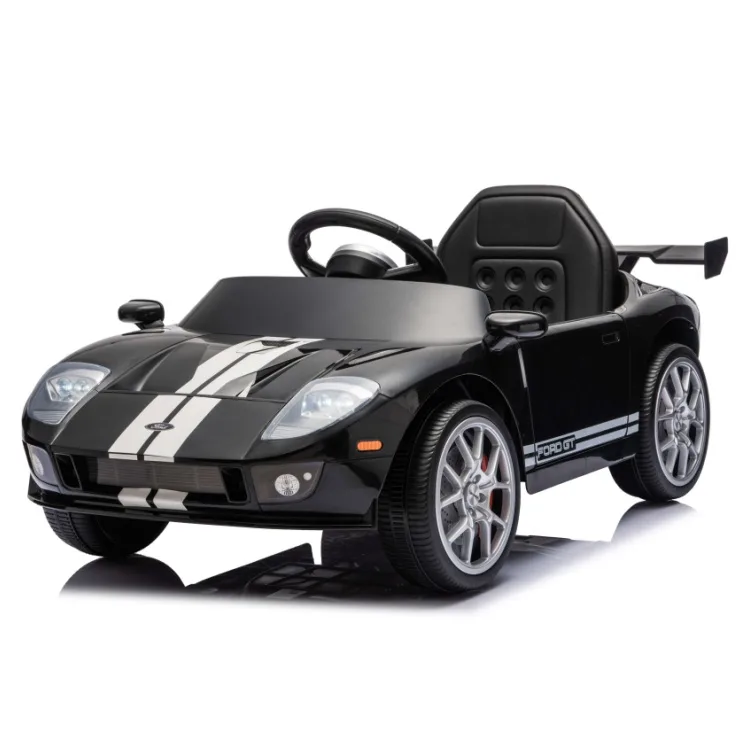
From a buyer’s perspective, wide color coverage translates directly to shelf appeal. A retailer or distributor stocking 5–6 colors can create a visual brand block that commands attention in a showroom or e-commerce listing grid. It also allows market-specific color curation — pastels for certain Asian markets, bold primaries for the Middle East, muted tones for Northern Europe — without changing suppliers.
What This Means for B2B Buyers in 2026
The convergence of licensing, multi-configuration platforms, dense certification coverage, and technology trickle-down is creating a new baseline for what constitutes a competitive ride-on car product. Buyers evaluating suppliers in 2026 should be asking:
4. What is your container load efficiency for this model?
5. Can you mix colors and configurations within a single MOQ?
The suppliers who can answer all five with specifics — not promises — are the ones positioned to lead the category as it matures from a commodity trade into a branded, licensed, and technically differentiated industry.
CHITUO Toys is a China-based manufacturer and exporter of licensed children’s electric ride-on vehicles. The company holds Ford, Mercedes-Benz, and additional OEM licensing partnerships, with products certified to EN71, EN62115, ASTM-F963, CPC, CCC, and SOR standards. For trade inquiries, visit chituorideon.com.
Post time: May-28-2026